
Understanding Quotation Marks in Writing
We use quotation marks to quote other people. But when you look inside the quotation marks in AI-generated drafts, often what's inside isn't actually someone else's speech. We analyzed 85 articles (totaling 399,943 characters) published across two sites, pulling out all 442 pairs of quotation marks and 236 pairs of parentheses to categorize what was inside. Out of the 250 instances where the content was a single word, 192 were full sentences. Of those sentences that seemed like someone was speaking, only 25 were actual statements; the rest were either sentences the AI invented to argue a point or examples it created. The parentheses were surprisingly fewer. Out of 6,116 sentences, only 109 contained parentheses, which is just 1.8%.
Quotation Marks: 442 Instances, A Three-Fold Difference Between Sites
We counted four types of quotation marks (single opening ‘ ’ and closing ‘ ’; double opening “ ” and closing “ ”; straight ” and straight ‘) in the main body text, excluding code blocks and inline code.
| Category | Number of Posts | Character Count | Quotation Marks | Per 1,000 Characters | Parentheses | Per 1,000 Characters |
|---|---|---|---|---|---|---|
| WordPress/Server Posts | 38 | 178,595 | 89 | 0.50 | 121 | 0.68 |
| AI Writing Posts | 47 | 212,348 | 353 | 1.66 | 115 | 0.54 |
| Total | 85 | 390,943 | 442 | 1.13 | 236 | 0.60 |
The usage of parentheses is relatively similar across both categories, but the quotation marks show a difference of 3.3 times. Server posts tend to use inline code for commands and file names, so they don't need as many quotation marks. AI-generated posts, however, deal with expressions, sentences, and prompts, which require more quotation marks. This difference is tied to the topic, so it's not inherently a problem. The real issue is what's actually inside those marks.
Regarding the style of the marks, we found 201 single opening/closing quotes (‘ ’), 142 double opening/closing quotes (“ ”), 51 straight closing quotes (”), and 48 straight opening quotes ('). Twenty posts mixed more than two types of quotes within a single piece, and four posts used three different types. This resulted from the editor automatically converting quotes to curved types while straight quotes were present in the initial draft.
What's Inside the Quotes: Five Categories
We broke down the 442 instances found within quotes into five categories. We defined a "sentence" as anything with a proper ending and spacing, or anything over 6 characters, or anything over 18 characters.
| Content Type | Count | Percentage | Examples |
|---|---|---|---|
| Word or Term | 250 | 56.6% | 'as is', 'recommendation', 'Starter·Pro·Turbo' |
| Declarative Sentence | 93 | 21.0% | "It's safe if the amount is small," "AI attacked Hugging Face" |
| Instruction or Prompt | 49 | 11.1% | "Make it pretty," "Do not write comments" |
| Question | 28 | 6.3% | "Can I recover files even if the admin screen is locked?" |
| Screen Message | 22 | 5.0% | "Invalid JSON response," 'Failed to connect to your source site' |
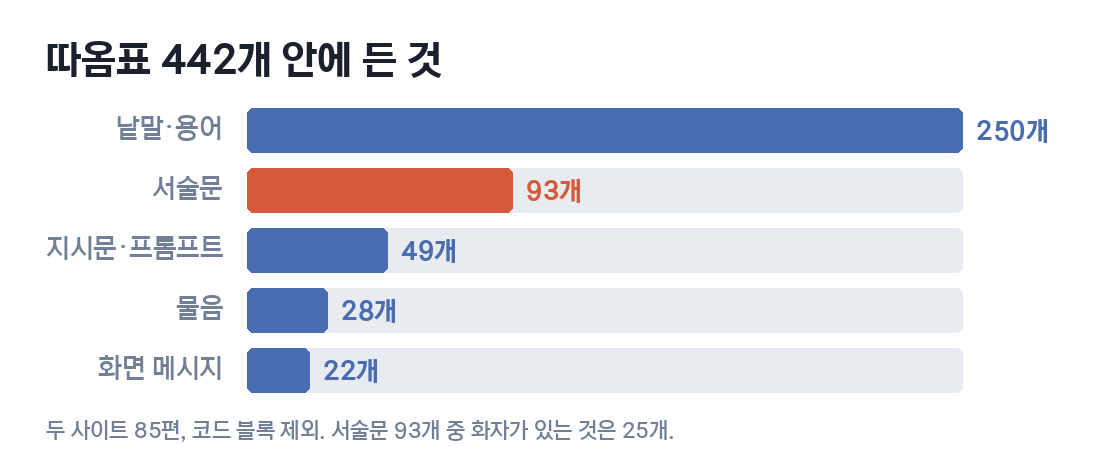
The 49 instructions and 22 screen messages are cases where the quotes served their purpose. Prompts entered by users into AI, or text displayed by WordPress, aren't the author's words, so they need to be separated with quotes. The 28 questions are also clearly defined because they mostly represent questions a reader might ask. What's left are the 93 declarative sentences.
Of the 93 Declarative Sentences, 68 Have No Speaker
We checked the 20 characters before and after the declarative sentences to see if there was a speaker or a verb of utterance like 'said,' 'stated,' 'claimed,' 'explained,' 'answered,' or 'expressed.' We found 25 instances with a speaker and 68 without one (73.1%). When you read the 68 instances without a speaker alongside the context, one recurring pattern emerges.
- If you just summarize this incident as "AI attacked Hugging Face," you're missing the bigger picture.
- You shouldn't just decide that "small amounts are safe."
- It's a mistake to think, "Uploading backup files is the end of it."
- Calculating that "since it's a 4-bit model, I only need one-fourth of the original" won't be enough in a real-world setup.
The structure here is that someone puts a sentence in quotation marks that sounds good for an AI to argue against, without anyone actually saying it, and then immediately refutes it. This pattern—like "If you only look at X, you miss Y," "It's tricky to judge by Z," or "Be careful with the phrase A"—appeared in 36 out of 93 descriptive sentences (38.7%). Readers tend to take these as if someone actually made those claims, making it seem like the writer is arguing against a hypothetical opponent. This framework was most common in articles analyzing AI models or recent events. The articles with the most quotation marks (13) were different because they were full of examples, while the next most frequent were news analysis pieces.
On the flip side, the 25 instances where a speaker was present were mostly quoted material, similar to the examples in our previous article, "Why 'According to the Provided Data' Sticks Around" (According to the provided data), where the source of the statement is clearly identified. Even with quotation marks, the difference between a direct quote and a straw man comes down to whether a subject is present before the marks.
Where Did the 236 Parentheses Go?
Parentheses were used less often than quotation marks, and their usage was pretty straightforward. In 29 out of 85 pieces (34.1%), there weren't any parentheses at all, and the average article had only 2.8. Two articles used 21 or more, but both were lists of measured figures, so most of the content inside the parentheses was percentages.
| Content Inside Parentheses | Count | Percentage | Examples |
|---|---|---|---|
| Numbers/Units | 67 | 28.4% | (31.5%), (200~230ms), (1 million tokens) |
| English Terminology | 64 | 27.1% | (Display Name), (URL), (Single Source of Truth) |
| Korean Explanation | 46 | 19.5% | (Private), (After Fixing), (User Setting) |
| Mixed Content | 34 | 14.4% | (Zig → Rust), (Korean Time Day 13) |
| Paths/Code | 24 | 10.2% | Containing inline code or file paths |
| Examples (e.g.:) | 1 | 0.4% | (e.g.: ...) |
The character count inside the parentheses averaged 6 characters with a mean of 8.5 characters, and only 3 instances exceeded 31 characters. The longest one was a whole sentence like "(Estimation based on 10-second intervals, so the error is within that)," and for things like this, it's better to rewrite the parentheses as a full sentence. In terms of titles, parentheses appeared in 1 out of 85 articles, and in 1 out of 751 subheadings; parentheses were only used within the body text.
178 Combined Words vs. 55 Separated Words
I looked at the characters right before parentheses. 178 instances (75.4%) had them attached directly to the preceding word, while 55 instances (23.3%) had a space before them. The attached ones often contained multiple pieces of information or numbers, like '(memory_limit)' or '(31.5%)', whereas the spaced ones usually held explanations for the entire sentence, such as '(excluding static files and server requests)'. This wasn't so much a strict rule as it was just how the initial drafts came in and weren't corrected. Only 17 paragraphs had two or more sets of parentheses, which is just 0.7% of the 2,383 paragraphs. I didn't really find any paragraphs that were so cluttered with parentheses that they were hard to read.
What I Decided to Change
- When putting a quote inside quotation marks, I always put who said it right before or after the quote. If I can't name the speaker, I'll drop the quotation marks and rephrase it as the writer's statement, like "it seems that..."
- I removed instances that just read like, "Simply '...'." If there's a specific point to counter, I'll cite the source; otherwise, I won't include a counterargument.
- I standardized the style of quotation marks within a text. I decided to use single quotes (' ') for words and terms, and double quotes (" ") for direct quotes and prompts. Straight quotes will only be used inside code blocks.
- If the content inside parentheses forms a complete sentence, I'll expand it into a full sentence instead of keeping it in parentheses. Parentheses will only be used for numbers, combined data, or very short explanations (15 characters or less).
- I decided to attach parentheses directly to the preceding word. If the explanation applies to the whole sentence, I'll write it as a separate sentence instead of putting it in parentheses.
How I Measured It
I analyzed the body text of 85 public posts from two different sites. I stripped out any