
How to Standardize List Endings in Writing
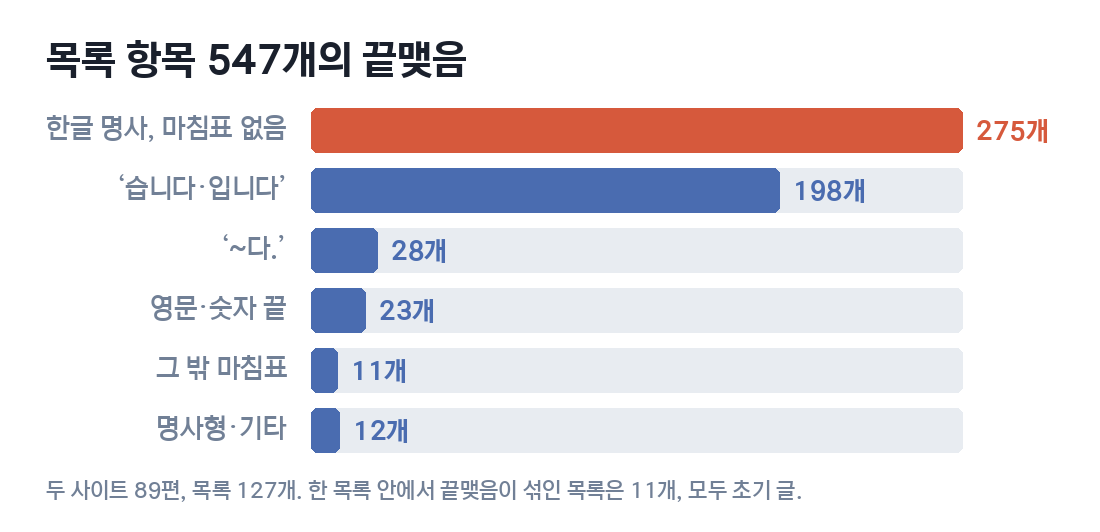
When it comes to AI-generated drafts, lists are one of the trickiest parts to nail. You have to decide if each item is a full sentence or just a single word, and whether it needs a period or not—and this varies from one piece to the next, even within the same list. We analyzed 89 articles across two sites, pulling 127 lists and 547 individual items. Out of those 547 items, 275 (50.3%) ended with a noun with no punctuation, 198 (36.2%) ended with 'formal polite ending,' and 28 ended with '~plain form ending.' We found that only 11 of the 127 lists had mixed endings.
Only one of the 127 lists appeared immediately after a subheader; the other 126 followed a paragraph. In terms of item count, four items was the most common, with three to five items making up 73.2% of the total.
Analysis of 127 Lists Across 89 Articles
We counted both unordered (ul) and ordered (ol) lists in the main body of the articles, excluding titles and tables. On the WordPress/Server articles (40 pieces), we found 79 lists, while on the AI Writing articles (49 pieces), we found 48 lists. The server articles tend to have lists nearly twice as often because they often detail procedures and checklist items.
| Metric | Value |
|---|---|
| Total Number of Lists | 127 (98 unordered, 29 ordered) |
| Nested Lists | 0 |
| Total Number of List Items | 547 |
| Average Lists Per Article | Average 1.43, Median 1, Max 7 |
| Articles with No Lists | 17 pieces (19.1%) |
| Average Items Per List | Average 4.31, Median 4, Max 10 |
| Average Item Length | Average 34 characters, Median 28 characters, Min 2 characters, Max 160 characters |
| List Proportion of Body Text | 14,716 characters / 311,610 characters (4.7%) |
When looking at the number of items per list, we found 27 lists with 3 items, 35 lists with 4 items, 31 lists with 5 items, and 17 lists with 6 items. Lists with three to five items make up 93 lists, or 73.2% of the total. We also found 10 lists with only 2 items, 1 list with just 1 item, and 6 lists with seven or more items. Interestingly, in human-written content, we didn't find a single list with more than ten items, and conversely, there was only one list with just a single item.
Regarding the number of lists per article, 42 articles had only one list, which was the most common. Two articles had seven items each, but both of those were from the early server posts.
List Endings: 275 Nouns vs. 198 'formal polite ending'
| Ending Type | Count | Percentage | Example |
|---|---|---|---|
| Korean Noun (no period) | 275 | 50.3% | Page cache |
| 'formal polite ending' or 'is/am/are (formal polite)' | 198 | 36.2% | ...a cron job pops up for every request. |
| '~plain form ending.' (Declarative) | 28 | 5.1% | ...confirms. |
| English or Number Endings | 23 | 4.2% | oEmbed API |
| Other Punctuation | 11 | 2.0% | — |
| Noun Form (nominalizer (noun form), thing/fact, nominalization (noun form)) | 7 | 1.3% | — |
| Other | 5 | 0.9% | — |
The endings that are nouns and those that end with 'formal polite ending' are roughly equal. Neither is inherently wrong, but the issue arises when they are mixed within a single list. Out of the 127 lists, 116 had a consistent ending type, while 11 were mixed. All 11 mixed lists came from the first 62 posts, and zero mixed lists appeared in the recent 27 posts. All 28 lists ending in '~plain form ending.' also originated from the early posts. In some cases, the main body used 'formal polite ending,' but the list items ended with 'does (plain form),' which is a habit from drafting lists like notes.
Differences Between Early and Recent Posts
We divided the content into the initial 62 posts (before post number 131) and the subsequent 27 posts. The latter 27 posts are those that were converted into actual measured content.
| Category | Early 62 Posts | Recent 27 Posts |
|---|---|---|
| Number of Lists | 96 | 31 |
| Total Items | 415 | 132 |
| Noun Endings | 259 (62.4%) | 23 (17.4%) |
| 'formal polite ending' Endings | 100 (24.1%) | 98 (74.2%) |
| '~plain form ending.' Endings | 28 | 0 |
| Mixed Ending Lists | 11 | 0 |
| Median Item Length | 24 characters | 57 characters |
In the early drafts, list items were mostly noun phrases around 24 characters long. However, in more recent posts, the standard item is a sentence up to 57 characters. Recent posts tend to place lists where conclusions or procedures go—like "Things to Confirm," "Summary of Measurement Methods," or "Criteria for Revision"—which is why some items have become longer, essentially acting as concluding sentences. Early posts, on the other hand, often featured lists that were just strings of nouns, such as "Items to Check" or "Potential Causes." It's less about which style is better and more about how the usage has evolved, but we've started seeing items exceed 100 characters in recent writing. There are 16 items over 100 characters, and one item clocked in at 160 characters, which was structured as "Name: Description" to fit an entire confirmation process into a single item.
Only One List Followed a Subheading Directly
I looked at what came before the 127 lists. Only one instance had a list immediately following a subheading; the other 126 were placed after a paragraph. In the initial drafts, there were hardly any instances where a list followed a subheading right away; they almost always followed an explanatory paragraph. If you map out where the lists fall according to the subheadings, there are 9 within the first subheading, 13 within the last subheading, and 105 in the middle sections. Those final 13 lists were typically used for procedures or checklists, like "Summary of Measurement Methods" or "Items to Check Before Distribution."
| What Preceded the List | Count |
|---|---|
| Paragraph | 126 |
| Subheading | 1 |
Looking inside the items, 83 items (15.2%) consist of two or more sentences. Forty-eight items have text bolded at the beginning. Sixty-two items use the "Name: Description" format, and 54 items contain code. When looking at the first word of an item, "Comment" led with 10 instances, followed by "WordPress" with 8, "Specific" with 8, and "Login" with 8. The words "I" and "However," which topped the list in the main body text, do not rank highly in the lists. List items start directly with a noun, without any connecting adverbs.
Where Tables and Lists Appear
When I counted 129 tables, they were heavily concentrated in the thirteenth column and fifth row. The lists, on the other hand, are clustered around the fourth item. Since 73% of the items fall between the third and fifth, it seems like when the initial draft was created, the writer likely adjusted the count by adding or removing one item relative to the fourth. Even if the actual content was seven items, the tendency is to reduce it to five, or if it was two items, to expand it to three. Since this measurement doesn't tell us what the original count should have been, I'm holding off on making any judgment.
Our Established Guidelines
- All list items within a single list must maintain a consistent ending style. If the item is a full sentence, it must end in a formal declarative form (like 'formal polite ending'). If it is a single word or phrase, it must end without punctuation.
- Any item ending in the informal declarative form ('~plain form ending.') will be changed to the formal declarative form ('formal polite ending') because it clashes with the rest of the body text.
- If a list item spans more than two sentences, it should be rewritten as a standard paragraph instead of remaining in the list format. Any item exceeding 100 characters is subject to review.
- The total number of items must align with the actual content. If there's any evidence that items were added or removed just to meet a specific count, we will revert those changes.
- We are keeping the current structure where a list does not immediately follow a sub-heading. We will not create standalone lists that consist only of list items without any introductory explanatory paragraph.
How We Measured It
We analyzed 89 public articles from two different websites. We counted the <li> tags found within the <ul> and <ol> tags. For the text of each item, we stripped away any HTML tags and removed leading or trailing whitespace; the length was measured by character count. We categorized the endings as follows: if an item ended in 'polite ending', we classified it as 'formal polite ending' or 'is/am/are (formal polite)'; if it ended in 'plain form ending.', we classified it as a statement; if it ended in Korean characters without a period, we classified it as a noun; and if it ended in English, numbers, parentheses, or percentages, we classified it as alphanumeric. Initially, we only tracked 'formal polite ending' and 'is/am/are (formal polite),' which caused forms like 'rises/floats (formal polite)' or 'sees (formal polite)' (ending in 'formal polite ending') to be incorrectly counted as statements. We corrected this by changing them to the proper form and recounting. To determine if something preceding a list item was part of the list, we checked if the preceding HTML was a closing tag for a heading. The division between the initial set and the recent set is at article number 131. Since both sites use the same numbering system, this acts as a proxy for time. The body text character count excludes code blocks and counts only the characters after removing spaces.