
Analyze Your Blog's Internal Linking Strategy
I used AI to draft content, and I ended up with 81 blog posts. For each post, I manually added two links pointing to different articles. However, I never took a step back to see the big picture of how all those links were connecting. Today, I pulled every link from those 81 posts to see exactly where they were pointing. I found a total of 130 links, and nearly half of my posts weren't receiving any links at all. To top it off, four of them were pointing to posts that no longer exist.
The Big Picture: 130 Links
I extracted all the `` tags from the body content and filtered them to only include links pointing to articles on my two blogs. I counted the rest as external links.
| Category | Count |
|---|---|
| Total Posts | 81 |
| Internal Links | 130 |
| External Links | 25 |
| Posts with Zero Links | 14 |
| Reciprocal Link Pairs | 5 pairs |
The outgoing links varied from 0 to 5 per post. Most posts fell into the 0 (20 posts), 1 (21 posts), or 2 (24 posts) categories. Since I set a rule to include two links, it made sense that the two-link posts were the most numerous.
Half My Posts Aren't Receiving Any Links
The real issue was on the receiving end.
| Links Received | Number of Posts | Percentage |
|---|---|---|
| 0 | 37 | 45.7% |
| 1 | 16 | 19.8% |
| 2 | 10 | 12.3% |
| 3–5 | 12 | 14.8% |
| 6 or More | 6 | 7.4% |
Looking at the two sites, kilho.org had 16 out of 36 posts linked to (44.4%), and damyo.net had 21 out of 45 posts linked to (46.7%). They are almost identical. This suggests the problem isn't related to the topic or the type of content, but rather the way the links are being implemented.
The Unlinked Posts Weren't the Newest
At first, I assumed the most recently published posts hadn't received links yet. It's natural to think that links are added later, so new posts would be lagging behind. However, when I broke it down by publication month, the opposite was true.
| Publish Month | Total Posts | Posts with 0 Links | Percentage |
|---|---|---|---|
| June 2026 | 3 | 2 | 67% |
| July 2026 | 37 | 20 | 54% |
| August 2026 | 26 | 11 | 42% |
| September 2026 | 15 | 4 | 27% |
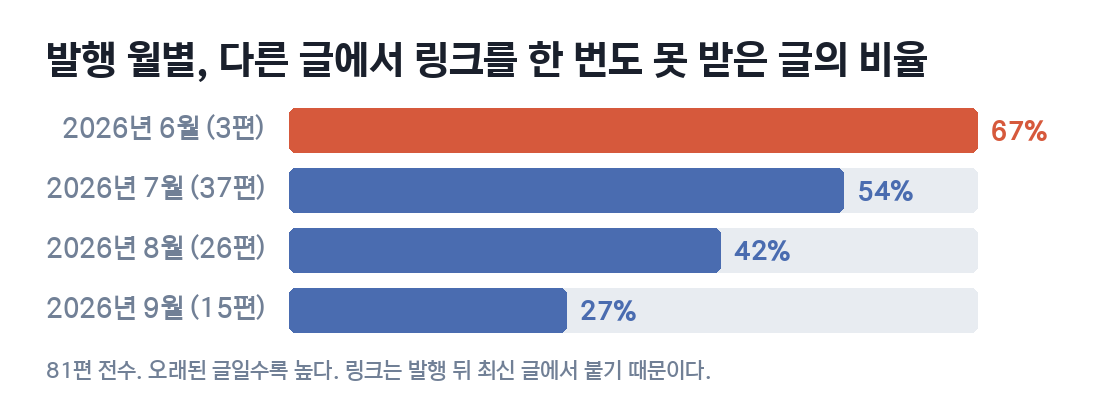
If we cut it off at August 10th, the trend becomes even clearer. Out of the 34 posts published after that date, 11 (32.4%) had zero links, compared to 26 posts (55.3%) from the 47 posts published before that. It seems that older posts tend to get forgotten rather than accumulate links. When I was linking, my pool of potential candidates was narrowing to the most recent few posts.
In fact, the 44 posts that did receive links took an average of 25.8 days, with a median of 21 days, to get their first link after publishing. This suggests that if you don't get a link within three weeks, it's unlikely you'll get one later.
Only Six Posts Were Receiving the Bulk of the Links
I didn't just look at the posts that weren't getting links; I also checked the ones that were getting a lot. The top six posts received 43 links, which accounted for 33.1% of the total 130 links.
| Times Linked To | Publication Date | Article Topic |
|---|---|---|
| 9 times | 2026-08-13 | Structuring content to provide context for AI |
| 8 times | 2026-08-08 | Background on model pricing and policies |
| 8 times | 2026-08-12 | Criteria for comparing model performance |
| 6 times | 2026-07-22 | How to connect tools |
| 6 times | 2026-07-27 | Prompt design rules |
| 6 times | 2026-07-28 | Real-time voice processing structure |
The common thread among these six articles is that they serve as background material for later posts. If you're writing about a new model, you need a piece that explains the comparison criteria. If you're writing about tool setup, you need a piece that explains where to place the context. So, just because something is old doesn't mean it gets forgotten. Only the articles that have a place to serve as background remain; the ones that are read once and then ignored tend to get pushed down.
What’s interesting is that the article with the most links—the one linked to 9 times—actually has zero outgoing links. It's referenced, but it doesn't reference anything else.
On the flip side, there were 20 articles that had absolutely no outgoing links. If you look at them chronologically, you can see where the pattern breaks. All eight articles published after September 4th have two links each. From September 1st to September 3rd, they have either one or zero. Before that, it was all over the place. This pinpoints the moment when the two-link rule was established. Once a rule is set, it tends to be followed afterward, but anything that accumulated before the rule was made stays as is unless you actively change it.
Four Links Were Pointing to Non-Existent Posts
While cross-referencing the links with the actual list of posts, I discovered that four of them pointed nowhere. All four were pointing to the same post.
kilho.org/32 (2026-07-07) Anchor[Thumbnail] -> kilho.org/135
kilho.org/68 (2026-07-13) Anchor[Thumbnail] -> kilho.org/135
kilho.org/87 (2026-08-13) Anchor[Thumbnail] -> kilho.org/135
kilho.org/122 (2026-08-16) Anchor[Upload Folder] -> kilho.org/135
Post #135 had actually been moved to the trash later on. When I tried to access the URL directly, I got a 404 error. WordPress doesn't affect the body text of other posts when a post is sent to the trash. Since the URL in the body is just a string of text, this was expected. However, the post that was deleted silently caused the four remaining posts to direct readers to a 404 page.
I removed the four problematic links and left the anchor text as it was in the body. I considered linking to a different post, but if the replacement post didn't convey the same meaning, keeping the link was worse. After fixing everything, I recounted, and there were zero broken links, and all four posts loaded correctly.
Why I Checked the 65 Links Pointing Backwards
While counting, I noticed something odd. Out of 126 links, 65 of them were pointing to posts that were published *after* the linking post. For example, a post from July was linking to a post from late August.
I checked the final modification date of the source posts, and the answer became clear. All 65 of those source posts had a final modification date that was later than the publication date of the target post. This meant someone had added the link to an older post after it was already published, which wasn't an error. Out of 81 posts, 67 of them had been modified at least once after publication.
I almost wrote, "Half of the links travel through time," just based on the ratio. But after pulling up the 65 instances along with their modification dates, I realized it was actually normal. When you see something strange, don't just rely on a ratio; you have to pull the individual items out and examine them within their context. This was also true when I was counting numbers.
Anchor Text: Short and Repetitive
I counted the words used in the links. Out of 130 links, there were only 64 unique terms—meaning half of them were words I'd already used somewhere else.
| Anchor Text | Usage Count |
|---|---|
| Context | 9 |
| Benchmark | 7 |
| Voice | 6 |
| GPT-5.6 | 6 |
| Claude Code | 6 |
| REST API | 5 |
Zero links used the full URL as the anchor text. I kept that rule. However, sometimes the same word is used in multiple places to point to different destinations. If two links use the anchor text "Context" but lead to different articles, a reader won't know which one to click just by looking at the words.
Why AI Draft Content Struggles with Linking
This isn't a problem you can fix by just editing the draft. When you ask an AI to write something, you give it the topic of that single piece. It doesn't have access to the 80 existing titles and URLs you already have published. So, the initial draft has no internal links at all; a human has to add them once the piece is ready to go live. It's the same spot as when you look at the content of an article, like this one: What the body of the article looks like. The draft is a self-contained unit, and the relationships between different articles are built externally.
When a human adds the links, their memory has limits. Some recent posts come to mind easily, but posts from two months ago are forgotten. The monthly chart above shows the shape of that memory. As long as linking is manual work, older posts keep getting pushed down.
What I'm Changing Next
Today, I only removed the four dead links. I didn't fix the rest. While adding links to the 37 posts with zero links would improve the numbers right now, it would result in putting in links that don't make sense. Instead, I've established new standards for future writing.
- For any two links, one must come from the last five posts, not just the most recent ones. This prevents us from only narrowing down the candidates to the newest articles.
- Before choosing links, I first check the list of articles that haven't received any links yet. Right now, that number is 37, and I aim to reduce that count.
- When I archive a post (put it in the trash), I check if any other articles are currently linking to it. The four dead links today were created because I skipped this check.
- If an anchor word has already been used for another destination, I'll make the anchor text longer. 6.6 characters isn't long enough to clearly distinguish between targets.
The Takeaway
In Part 81, there were 130 links, and four of them were leading to 404 errors. Furthermore, 45.7% of the content wasn't receiving any links, and those were all older posts, not recent ones. Since I made sure to include two links every time I published something, I thought I was following the rules, which is why the issue wasn't obvious.
The rules only specified what to do with the outgoing links—the ones you are sending out—but nobody was tracking what was happening on the receiving end.
These kinds of gaps naturally pop up when you're using an automated system to generate drafts. While you can spot issues within a single post during the drafting phase, if the problem spans multiple posts, it won't give you any warning signs until you actually start counting.
As the number of posts grows, this discrepancy just gets bigger.