
How Bold Text Use Affect's Your Writing
How do you tell the difference between a post written directly from an AI draft and one that's been polished by a human? Since we already checked sentence structure and endings, we focused on the use of bold text. We pulled every <strong> tag from 72 public posts, totaling 349,000 characters across both blogs. The results were stark: 45 posts had zero bold text, while the remaining 27 posts averaged 11.6 instances. There’s no middle ground.
Is It Zero or More Than Ten?
Here is a table showing the distribution of bold sections per post.
| Bold Sections Per Post | Number of Posts | Percentage |
|---|---|---|
| 0 | 45 posts | 62.5% |
| 1–5 | 7 posts | 9.7% |
| 6–10 | 10 posts | 13.9% |
| 11–15 | 5 posts | 6.9% |
| 16–20 | 1 post | 1.4% |
| 21+ | 4 posts | 5.6% |
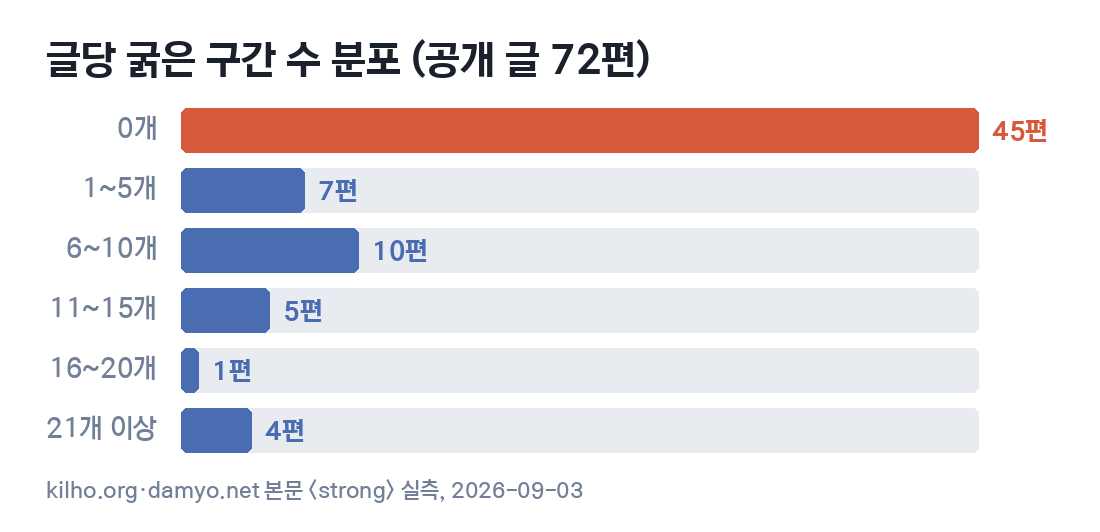
The 45 posts with zero bold text are those published straight from the draft. AI drafts don't add emphasis on their own. While they cover every sentence, they don't flag which ones are important. They write everything in a flat tone, as if no sentence is more important than any other.
On the flip side, the 27 pieces we looked at contained 314 instances of bold text, averaging about 11.6 per piece. Only 7 pieces had 1 to 5 instances, and most went over 6. Once you start using it, it doesn't just stop at a couple of spots—it becomes a habit. We'll cover this more later.
Bold Text Makes Up 1.7% of the Body
When looking at character count, the bold text accounts for 6,068 characters, which is 1.7% of the total. If we only look at those 27 pieces, that percentage jumps to about 4%. This means one out of every twenty characters is bold. For the reader, this level is enough that they can grasp the main points just by reading the bold text. But the real question is: is that framework actually the core message of the writing?
Where Did You Put the Bold Text?
I counted where those 314 bold segments were located within the paragraphs. I only counted paragraphs that had two or more sentences.
| Location in Paragraph | Count | Percentage |
|---|---|---|
| First Sentence | 52 | 22.6% |
| Middle Sentence | 101 | 43.9% |
| Last Sentence | 77 | 33.5% |
The first sentence was the least used. The opening sentence of a paragraph is usually where you introduce the topic, but the emphasis tends to pile up where the supporting evidence or the conclusion comes in. The 33.5% in the last sentence proves this. It seems people are bolding the concluding thought after they finish reading the paragraph.
This placement isn't inherently bad. The issue is consistency. If most of the 27 pieces emphasize the same spot in the same way, readers will quickly figure out the pattern and start skipping the bold text. The emphasis stops being effective emphasis.
In the Introduction, But Not the Conclusion
I also analyzed this at the paragraph level. Out of 2,096 total paragraphs, 225 (10.7%) contained bold text, and only 16 paragraphs had two or more instances of bolding. In other words, the rule was almost always to have only one instance of bold text per paragraph.
When I specifically checked the start and end of the pieces, 10 pieces had bold text in the introduction, while only 7 pieces had it in the final paragraph. Out of the 27 pieces, two out of every three didn't bold either the beginning or the end. Not having emphasis in the concluding paragraph can also mean you haven't decided what you want the reader to take away when the piece ends. The emphasis is used most often in the body, yet it disappears in the conclusion.
One Out of Three Uses an Entire Sentence
I also measured the length of the bold segments. The average length was 19.3 characters, with the shortest being 2 characters and the longest being 60 characters.
| Segment Length | Count | Percentage |
|---|---|---|
| 10 characters or less | 78 | 24.8% |
| 11–20 characters | 103 | 32.8% |
| 21–30 characters | 82 | 26.1% |
| 31–40 characters | 37 | 11.8% |
| Over 40 characters | 14 | 4.5% |
Also, out of 314 instances, 103 (32.8%) ended with the period ".". This means you bolded entire sentences, not just individual words. The 14 instances that were over 41 characters were essentially two full sentences.
When you bold an entire sentence, it ends up feeling more like adding a small subheading within the paragraph rather than providing emphasis. If all ten words in a sentence are bold, the reader still has to go back to figure out the main point. The whole reason you bold something is to say, "Look here," but by bolding the whole sentence, you lose that specific focus.
Most Frequent Words in Bold Text
I pulled the top words by counting the word groups within the 314 segments.
| Word Group | Frequency |
|---|---|
| same | 12 |
| exactly | 7 |
| average | 7 |
| most | 7 |
| has | 7 |
| again | 6 |
| not | 5 |
'Same,' 'exactly,' 'most,' and 'not.' These are all words used for comparison or reversal. The sentences you bolded were mostly structured like, "It's not A, it's B," or "The biggest thing is this." While this might mean you picked a good spot for emphasis, it also means the same pattern is repeating itself.
On the flip side, the titles had zero instances of bold text, and only 34 out of 465 list items (7.3%) were bolded. The emphasis was concentrated only within the paragraphs and didn't spread to other elements. In that regard, you did a good job.
Which is the problem: zero bolded words or twelve?
It's actually both. It just depends on your approach.
If you have zero bolded words, then every sentence carries the same weight. Your reader has to read all 4,000 characters at the same pace. Skimmers won't see anything to latch onto and will bounce. This often signals that the text is straight from an AI draft.
On the other hand, if you have twelve, you have weight, but the rules are visible. You might have one per paragraph, usually at the end of a sentence, or maybe an entire sentence every few paragraphs. After a while, the bolding just becomes background noise. This means you've moved past a draft and into the habits of someone who has polished the writing.
What you should aim for is a different count and different placement for each piece. Some articles might need three highlights, while others only need one. That judgment needs to change depending on the specific article so your emphasis actually lands.
How to Fix Your Text
- Start by trimming the bolded sections from the end of sentences. This applies to about 32.8% of your text. Cut everything except the two or three most crucial words in that sentence.
- If you have one highlight per paragraph, cut it in half. If the meaning still comes through without it, that emphasis wasn't necessary to begin with.
- For articles with zero bolding, try adding just one spot. This is about deciding where the single most important sentence should be. If you can't pinpoint that one spot, the article lacks a clear conclusion.
- If you see multiple instances of phrases like "same" or "not," remove one. When you repeat the same type of emphasis, it starts to look like a pattern rather than a point.
How to Count It Yourself
If you use WordPress, you can quickly count the bolded sections in a post using WP-CLI.
wp post get 123 --field=post_content | grep -o '<strong>' | wc -lIf you don't have a tool, just open the post and read only the bolded text aloud. If that reading alone tells you the whole point of the article, your emphasis is working. If you find yourself reading five or six sentences in a row without a break, you have too much sentence-level emphasis. If you read nothing, it's likely a raw AI draft.
The Takeaway
Out of the 72 pieces we looked at, 45 had zero instances of bold text, and 27 averaged about 11.6 instances. For the first draft, we didn't use any emphasis, and for the revisions, we applied bolding according to the rules. However, from a reader's perspective, both types of writing fail to tell the reader where they should be looking.
Emphasis isn't about the sheer number; it's about making good choices. Try removing the bolding from entire sentences, cutting the instances down to about half per paragraph, or picking just one spot for the pieces that have none. Just making these three adjustments will change the distribution across all 72 pieces.