
Why AI Subheadings Lack Variety
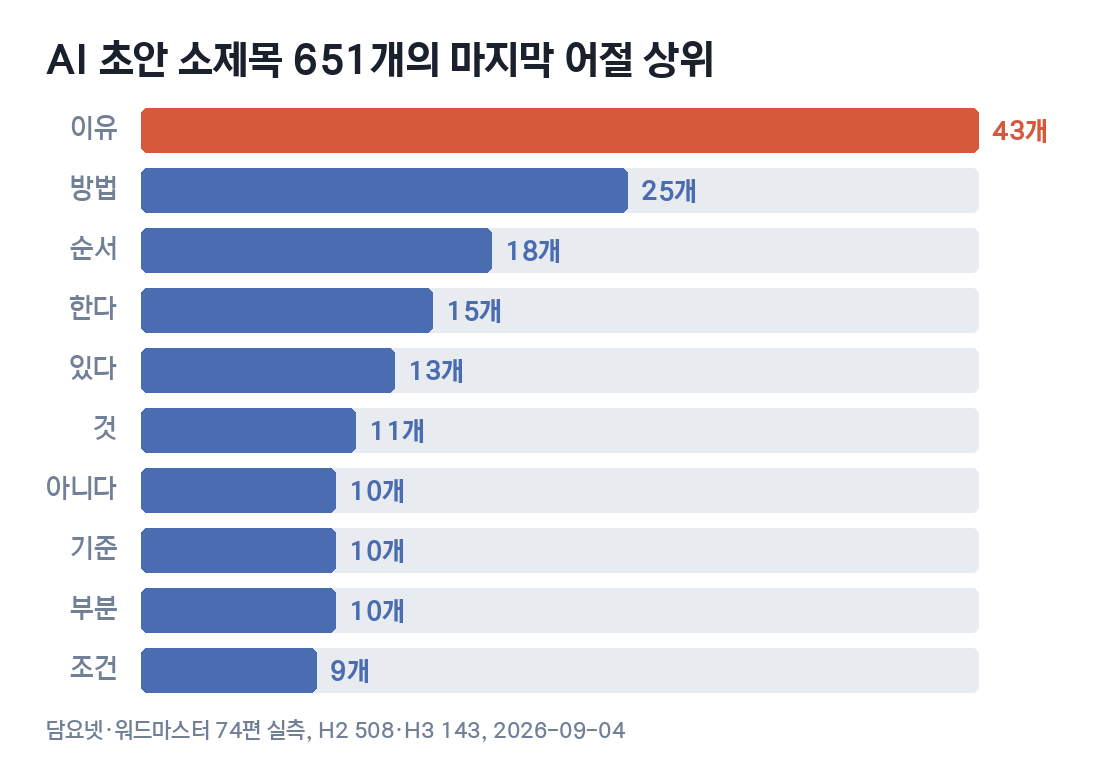
When you read content generated by AI, the first thing that usually catches your eye isn't the main body text—it's the subheadings. As you scroll through, it gives you this familiar, almost uncanny feeling, but it's hard to put into words. So, I decided to count. I pulled 651 subheadings from 74 articles across two blogs and tallied everything: length, word count, how they ended, and recurring phrases. Just looking at the endings told me the story. Out of those 651, 43 ended with "reason" (reason), and only 16 ended with a question mark.
What I Counted
My data set included 74 published articles from two blogs (33 on WordPress topics and 41 on AI topics), totaling 357,847 characters of body text. I extracted the text from the <h2> and <h3> tags in the body HTML, cleaned up the tags and spaces, and recorded the character count, word count, the final word, the final character, and any punctuation. The initial drafts were all AI-generated, but some were later edited sentence-by-sentence by a human. Since the subheadings were rarely touched during the editing process, they still carry the habits of the original AI drafts.
To put the results in a nutshell: out of 651 subheadings, 508 were H2s and 143 were H3s. On average, each article has 8.8 subheadings, with one subheading appearing roughly every 550 characters of body text.
Subheading Count Per Article: 59 Out of 74 Articles Have 6 to 7 H2s
| H2 Count Per Article | Number of Articles | Percentage |
|---|---|---|
| 5 | 2 | 2.7% |
| 6 | 30 | 40.5% |
| 7 | 29 | 39.2% |
| 8 | 6 | 8.1% |
| 9 or more | 7 | 9.5% |
A total of 59 articles—79.7%—have either 6 or 7 H2s. While the article length varies by a factor of 2.2, ranging from 3,584 to 8,054 characters, the number of H2s barely changes. Longer articles seem to absorb the extra length by having longer sections under each subheading. In fact, the body text length for a single H2 section ranged from a minimum of 161 characters to a maximum of 3,110 characters, averaging 627 characters. On the flip side, 28 articles had zero H3s, and only 46 articles used two or more. Most of these H3s were added later by a human editor. The fundamental structure of the AI draft ends with 6 to 7 H2s.
Subtitle Length Breakdown: Where Most Subtitles Land
| Word Count | Number of Subtitles | Percentage | Example |
|---|---|---|---|
| 1–2 Words | 57 | 8.8% | Theme Issue / Memory Shortage |
| 3–4 Words | 141 | 21.7% | Finding in Block Insert |
| 5–6 Words | 309 | 47.5% | The Role and Scope of QA for AI |
| 7–8 Words | 131 | 20.1% | Why You Must Finalize Audio Length Before Video |
| 9+ Words | 13 | 2.0% | When Contact Hosting vs. Deciding on an Upgrade |
When we look at character counts, the average is 20.2 characters, with the median sitting at 21 characters. About 30.1% of titles fall between 21 and 25 characters. Only 9.8% are 10 characters or fewer, and just 6.3% are over 31 characters. The shortest one was 2 words, and the longest clocked in at 49 characters. But the word count tells a clearer story. The 5–6 word range makes up nearly half, supported by roughly 20% from the ranges before and after, creating a bell curve. Human-written subtitles are often a mix of single words and full sentences, leading to inconsistency. However, in this dataset, there are zero subtitles with two words or fewer. This suggests that AI isn't very good at creating short, punchy headlines.
How Blog Post Endings Are Structured: Nouns vs. Questions
| Ending Format | Number of Titles | Percentage | Example |
|---|---|---|
| 467 | 71.7% | Why Backup and Restore Alone Isn't Enough |
| 25.8% | Try Multiplying Before Hiring More Workers | |
| 2.5% | Will Deleting xmlrpc.php Fix It? |
If you break down the 467 titles that end with a noun, you'll find that 246 of them (52.7%) take the form of a long descriptive clause followed by a single noun, like "the reason why..." or "the order you must follow." Short noun phrases, like "Theme Issue," make up only 54 titles, or 11.6%. For the 168 titles that end with a sentence, the final word is usually a definitive statement—like "does," "is," "is not," "differs," "sees," or "becomes"—with very few using past tense forms like "~did."
All 16 titles ending with a question mark came from the initial batch of WordPress blog posts. None of the 300 AI-generated blogs used a question mark. These titles usually look like, "Which method should I choose?" or "What is the gettext filter?". Even though they were drafted with the same tools at the same time, whether a title was interrogative or not depended on the topic: question formats appeared in WordPress troubleshooting posts but not in AI news posts.
Top 10 Most Common Final Words
| Final Word | Count | Percentage |
|---|---|
| 43 | 6.6% |
| 3.8% | |
| 2.8% | |
| 2.3% | |
| 2.0% | |
| 1.7% | |
| Each 1.5% | |
| 1.4% |
'Why' is overwhelmingly dominant, appearing 43 times. That’s 1.7 times more than the second most common term, 'How.' If you tally all the section titles ending in organizing nouns like 'reason,' 'method,' 'order,' 'standard,' 'condition,' 'item,' 'part,' 'structure,' or 'location' (19 types in total), you get 178 instances, which is 27.3% of the whole set. In four out of every ten instances, the title closes with a framework like "The Reason For X" or "The Order Of X." This framework isn't wrong. The issue is that it shows up in every single one of the 74 posts. If a human were writing these titles, around the 43rd time 'reason' pops up, you'd start seeing variations like 'What Causes This,' 'The Cause,' 'The Background,' etc. But here, 'Reason' holds that spot every single time.
The First and Last Section Titles
Six posts begin their first section title with 'First,' and three start with 'This Time.' The ending titles are even more telling. 'Conclusion' appears in 7 posts, and 'To Summarize' in 6. When you bundle in conclusions, summaries, and checklists, a total of 15 out of 74 posts (20.3%) end with titles of the same nature. We found 6 unique titles that were repeated verbatim in two or more posts, with 'To Summarize' and 'Conclusion' leading the pack at 7 times each. The rest were self-references from this blog's own analysis, like 'How We Counted It' (4 times) or 'How We Counted It' (2 times). Humans do repeat things, but you only see that repetition when you start counting it up like this.
31 Posts Repeat the First Word of the Title in the Section Headings
In 31 out of the 74 posts, the very first word of the main title (usually a tool name like 'WordPress,' 'AI,' or another software) reappears in the section headings. This means 37 of the section titles contained the initial keyword. It looks like the habit of stuffing keywords to satisfy search engines is lingering in the AI-generated drafts. Of those, 170 titles included English words (26.1%), while only 61 included numbers (9.4%). Titles with commas were rare at 11, and those with quotation marks were 13, with only 1 using parentheses. Another notable trend is the near absence of punctuation within the section titles themselves. A human writer would usually sprinkle in things like "In 3 Minutes," "(Optional)," or "Warning:" in their headings.
Comparing the Two Blogs
| Metric | WordPress Blog (33 Posts) | AI Blog (41 Posts) |
|---|---|---|
| Total Subheadings | 351 (Avg. 10.6 per post) | 300 (Avg. 7.3 per post) |
| Average Length | 19.0 characters | 21.6 characters |
| Ends with Noun | 70.4% | 73.3% |
| Ends with Sentence | 25.1% | 26.7% |
| Ends with Question Mark | 4.6% | 0% |
| Ends with 'Why' (reason) | 5.1% | 8.3% |
Even though the topics are different, there's only a 3 percentage point gap in the ratio of noun endings. The difference in the number of subheadings per post is likely because the WordPress blog includes more posts with H3 tags, but both sources maintain 6 to 7 H2s in their initial drafts. These numbers show that regardless of the topic you choose, the underlying structure and the typical ending words remain consistent.
What We Found When We Counted
- Having a fixed number of 6 to 7 H2 headings doesn't depend on the article's length. Shorter posts just have thinner sections, and longer posts have thicker ones; the heading count isn't adjustable that way.
- The format "Why [Action]" or "How to [Action]" makes up one out of four types. The easiest way to break this mold is to change one heading into a question or a short noun. In this set of 651 pieces, 8.8% were two words or less, and 2.5% ended with a question mark.
- The closing heading is identical in one out of every five posts. If you replace the final heading with a concluding sentence from the body text, it becomes a completely different piece.
- When you're revising a draft, it's easy to fix the body paragraphs while leaving the headings untouched. In this count, the headings were the area with the least human revision. This is similar to what we saw when we measured title length: the most visible parts were the least edited.
Keep in mind that this data is limited to the posts from these two blogs, and drafts created with different tools or prompts might show a different distribution. However, the counting method is the same. If you pull out the <h2> tags from the body and count only the last word of each, you can see in one line what kind of structure the draft is using to wrap up the piece.